The history of Monserrate: a chapel, three tenants and a state
The sequence, with its dates
| When | What happened |
|---|---|
| about 1093 | A chapel to the Virgin Mary stands here, after the reconquest of Sintra. |
| 1540 | A chapel to Our Lady of Monserrate is built on the hilltop. |
| 1789 | Gerard de Visme, an English merchant, rents the farm and builds a neo-Gothic house over the chapel ruins. |
| 1793–94 | William Beckford subleases the estate and begins the landscaped gardens. |
| 1856 | Francis Cook subleases the property. |
| 1863 | Cook buys it, and works with the architect James Knowles on what remained of de Visme’s house. It becomes the Cook family’s summer residence. |
| 1949 | The Portuguese state acquires the property. |
| 1995 | The Cultural Landscape of Sintra becomes a UNESCO World Heritage Site. Monserrate Park is within it. |
Who built Monserrate Palace?
Three people, in turn. The house you walk into was rebuilt for Francis Cook, who bought the property in 1863 and worked with the architect James Knowles on what was left of the neo-Gothic house Gerard de Visme had put up over the chapel ruins after renting the farm in 1789. William Beckford, in between, is the reason the park is a park: he subleased the estate in 1793–94 and began the landscaped gardens, and the waterfall on the operator’s list still carries his name.
So: de Visme built a house, Beckford began the park, Cook and Knowles made the building that is standing. It was the Cook family’s summer residence until the Portuguese state acquired it in 1949.
The style
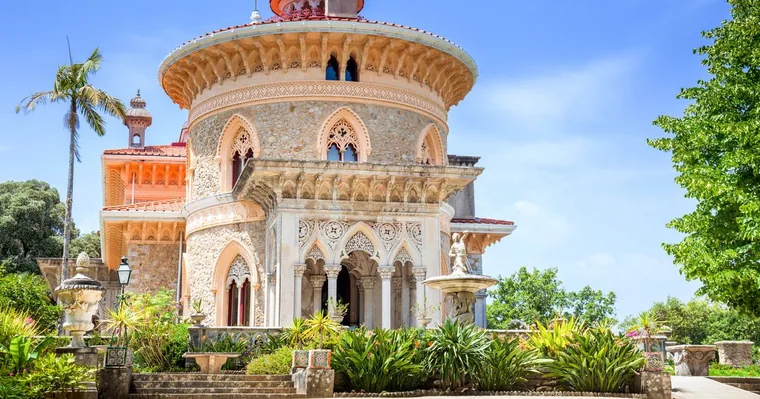
Romanticism and Mudéjar Moorish Revival with neo-Gothic elements — Sintra Romanticism. The neo-Gothic strand is not decoration for its own sake: de Visme’s neo-Gothic house of 1789 is what Cook and Knowles built on, and the Moorish Revival is the Victorian layer over it. Walk it with the free app audio guide in the ticket, which takes the ten rooms in the operator’s order. The rooms.
The UNESCO listing, and the wording of it
The Cultural Landscape of Sintra became a UNESCO World Heritage Site in 1995, and Monserrate Park is within it. The listing is the landscape — the hills, the palaces and the parks together — which is exactly why a Sintra day pairs so naturally: Monserrate, Pena, the Castle of the Moors and the rest are one listed landscape on one ticket line. How a day fits together.
Seeing it
If you read the history before you walk the park, two of the operator’s thirteen points of interest stop being names: Beckford’s Waterfall, and the Chapel that is the thread back to 1093. One ticket covers the park and the palace, booked ahead at the gate price with fast-track entry. The ticket, with live dates.
 Palace and park, fast-track
Sintra: Monserrate Palace & Park Ticket
 The one most people book
Lisbon: Sintra Full Day Pena Palace, Regaleira & Monserrate
 Private, entry included
Private from Lisbon: Sintra, Quinta Regaleira, Monserrate +
Read next
Frequently asked questions
What is the history of Monserrate Palace?
A chapel to the Virgin Mary stood here from about 1093, and a chapel to Our Lady of Monserrate was built on the hilltop in 1540. Gerard de Visme rented the farm in 1789 and built a neo-Gothic house over the chapel ruins; William Beckford subleased in 1793–94 and began the landscaped gardens; Francis Cook subleased in 1856, bought the property in 1863 and rebuilt the house with the architect James Knowles. The Portuguese state acquired it in 1949, and the Cultural Landscape of Sintra became a UNESCO World Heritage Site in 1995.
Who built Monserrate Palace?
Three tenants over three centuries. Gerard de Visme built a neo-Gothic house over the chapel ruins from 1789; William Beckford began the gardens in 1793–94; and Francis Cook, who bought the property in 1863, rebuilt the house with the architect James Knowles. It became the Cook family’s summer residence.
Is Monserrate a UNESCO World Heritage Site?
The Cultural Landscape of Sintra became a UNESCO World Heritage Site in 1995, and Monserrate Park is within it.
What architectural style is Monserrate Palace?
Romanticism and Mudéjar Moorish Revival with neo-Gothic elements — Sintra Romanticism.